Industry insight · 25 October 2023
Digital Twins and Simulations: Transforming Business Processes and Operations in Ports
A detailed introduction to digital twins, simulations and their potential role in port capacity, risk, traffic, cost and sustainability decisions.Introduction
In the era of Industry 4.0, businesses are turning to new technologies to become smarter and more efficient. Digital twins and simulations stand out as tools that can materially change how organisations understand systems, test alternatives and improve business processes.
01 — Fundamentals
What is a digital twin?
A digital twin is a one-to-one digital representation of an object, device, service or physical entity—such as a city, product, machine or port operation—created without physically reconstructing it.
Digital twins can be updated with real-world information from sensors, Internet of Things devices and other data sources. Analysing that information can reveal potential outcomes and support preventive action before a problem occurs in the physical environment.
One of the defining characteristics of a digital twin is its dynamic nature. As real-time data changes, the digital representation can change with it. This creates important advantages when teams need to understand the possible consequences of changing conditions.
02 — Cross-industry use
Where digital twins are applied
In manufacturing, digital twins can support production-line efficiency and product quality. In energy, they can help manage plants and grids, improve energy efficiency and anticipate failures. In healthcare, digital representations built from patient data can contribute to treatment and service improvement.
Cities can use digital twins to examine complex systems such as traffic flow, energy consumption and disaster management. Applications have also been developed in aerospace, defence, automotive and transportation to improve efficiency and reduce risk.
The growth of sensors, IoT and big-data analytics continues to expand the practical scope of digital twin technology. Cost pressure, operational optimisation and the need to bring goods and services to market faster are among the factors driving investment in this field.
03 — Market perspective
A rapidly expanding technology field
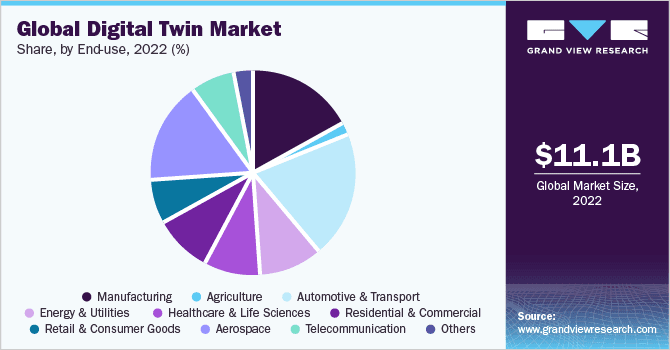
A study published by Grand View Research projected that the global digital twin market would reach USD 155.84 billion by 2030, with a compound annual growth rate of 37.5% between 2023 and 2030. This figure is retained here as part of the article's original 2023 context.
04 — Decision support
Digital twins, simulations and controlled analysis
Digital twins can be used together with simulations to model and analyse complex real-world systems. This makes it possible to examine operational situations and improvement alternatives without exposing the physical operation to the same level of risk.
The basic elements of simulation include models, data, data criteria, analysis and optimisation. Models represent objects, processes and systems; real-time or hypothetical data produces possible outcomes; analysis and optimisation turn those outcomes into structured decision support.
05 — Ports
The use of digital twins and simulation technology in ports
In 2021, global trade in goods and services reached USD 27.3 trillion, an increase of 24% from 2020. According to 2021 data, the transportation sector had a trade volume of USD 1.37 trillion, while the shipping industry directly employed more than 1.5 million people. These figures are retained as the historical context in which the original article was published.
Ports are major arteries of global trade and are managed through complex, interdependent operations. Digital twin and simulation technologies offer port operators a way to examine how those operations could become more efficient, secure and environmentally responsible.
Three-dimensional virtual representations can be created for ships, cranes, vehicles, equipment, containers and other cargo. The model can also include gates, storage areas, CFS areas and other physical parts of the terminal. Weather, IoT, sensor and third-party data can be brought into the same environment so that authorised teams can view the port at real scale and in operational context, regardless of their location.
When supported by simulation algorithms, digital twins can use historical and real-time data to explore possible operational processes before those processes are performed in the physical terminal.
Continue exploring
Connect the archive
to today's platform.
Explore how these milestones and industry perspectives connect with SOLONPORT's current platform and products.
Enter the spatial layer ↗Return to News & Events →